TIDES
Specialist analytical services for therapeutic oligonucleotides and synthetic peptides, the fastest-growing modalities in contemporary pharmaceutical development.
The term TIDES designates two of the most dynamic and rapidly growing therapeutic modalities in the contemporary pharmaceutical industry: therapeutic oligonucleotides and synthetic peptides. Although structurally different, these modalities share a characteristic that distinguishes them from conventional small molecule drugs and large-format biologics: they are molecules of intermediate chemical complexity, synthesised in a controlled manner but with properties that bring them closer to biological modalities in terms of specificity of action, required analytical sensitivity and regulatory stringency.
Therapeutic oligonucleotides — including antisense oligonucleotides (ASOs), small interfering RNA (siRNA), therapeutic mRNA, aptamers and splice-switching oligonucleotides — act by modulating gene expression at the nucleic acid level, offering the possibility of addressing targets previously considered inaccessible to conventional pharmacology. Synthetic peptides, in turn, range from short chemically synthesised peptides to complex designer peptide molecules, with applications spanning oncology, metabolic disease and endocrinology.
The analysis of these modalities requires specialised analytical platforms, dedicated scientific expertise and a thorough understanding of the applicable regulatory frameworks, which combine elements of both small molecule and biologics regulation. AMSbiopharma has developed a specific portfolio of analytical services for TIDES, covering both R&D and bioanalysis needs and those of CMC characterisation and quality control.
The regulatory framework applicable to TIDES services is inherently dual: bioanalysis and PK/PD services fall within the scope of Good Laboratory Practice (GLP) in accordance with OECD guidelines and the bioanalytical guidance of the EMA and FDA, while CMC characterisation and quality control services respond to the principles of Good Manufacturing Practice (GMP). Some advanced characterisation services may also be performed in non-regulated environments for exploratory phases of development. To determine the most appropriate framework for your programme, we invite you to consult our team.
Therapeutic oligonucleotides
Therapeutic oligonucleotides are short nucleic acid chains — typically between 15 and 30 nucleotides — designed to bind specifically to target RNA or DNA sequences and modulate their function. The incorporation of chemical modifications into the phosphodiester backbone and sugars — such as phosphorothioate groups, 2’-O-methyl modifications or locked nucleic acids (LNA) — is essential to improve stability against nucleases, optimise pharmacokinetics and reduce immunogenicity.
These modifications, which are precisely what confer therapeutic properties on oligonucleotides, also represent the primary challenge for their analytical characterisation: methods must be capable of precisely confirming the complete sequence of the oligonucleotide, identifying and quantifying impurity species — including truncated sequences, insertions and deletions — and evaluating the stability of the product against its various degradation pathways.
Synthetic peptides
Synthetic therapeutic peptides constitute a therapeutic class of enormous structural and functional diversity, ranging from short linear peptides of a few amino acids to complex cyclic molecules with multiple disulfide bridges or unnatural modifications. Their synthesis by solid-phase peptide chemistry (SPPS) enables the controlled production of highly specific molecules, but also generates a characteristic profile of process-related impurities — truncated peptides, insertion peptides, amino acid deletions — that must be identified, characterised and controlled in accordance with the requirements of ICH Q3A and ICH Q3B.
Therapeutic peptides include both innovative products — such as GLP-1 receptor agonists in diabetes and obesity, antimicrobial peptides or cell-penetrating peptides — and generic versions of established peptide drugs, for which the demonstration of analytical equivalence with the reference medicine is a key regulatory requirement.
Shared analytical challenges
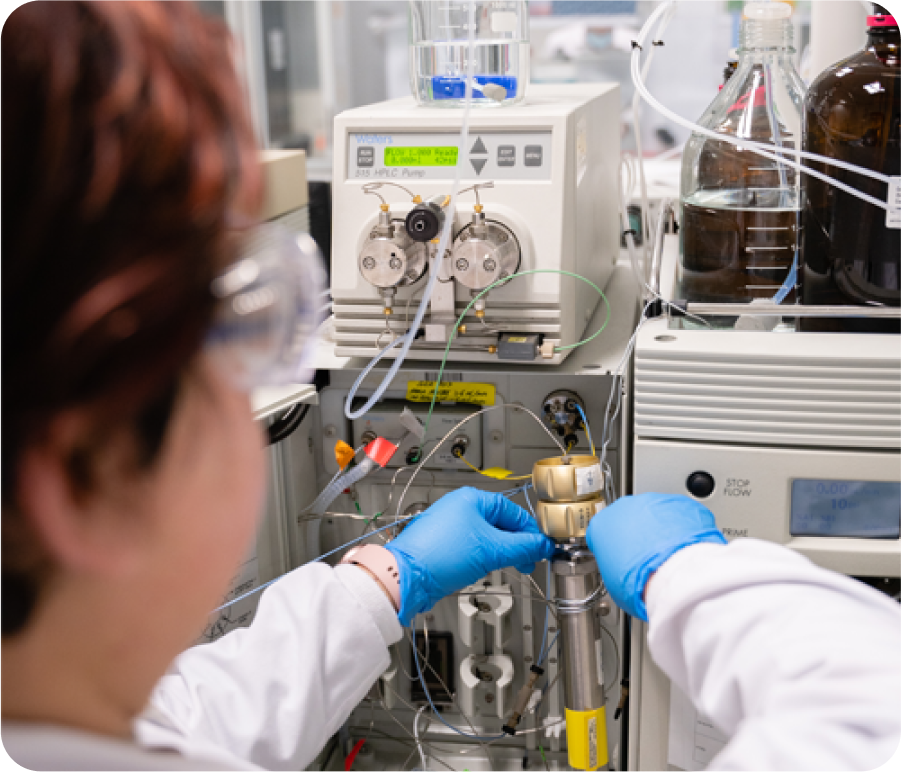
Both subcategories of TIDES share the need for high-resolution analytical platforms — particularly UHPLC with ion-pairing chromatography and high-resolution mass spectrometry (HRMS) — capable of resolving and quantifying molecular species with minimal differences in mass or sequence. Tandem mass spectrometry (MS/MS) is essential for sequence confirmation and structural identification of impurities, while bioanalysis methods in biological matrices demand exceptional sensitivity and specificity given the structural similarity between the drug and endogenous species.