
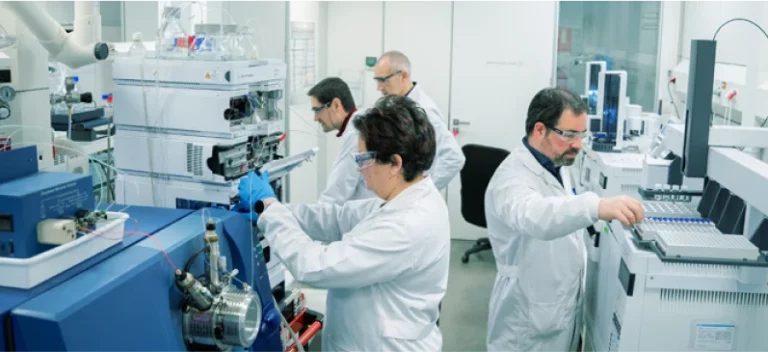
An antibody-drug conjugate combines a monoclonal antibody with a highly potent small-molecule drug, the payload, attached through a chemical linker. The antibody directs the drug to tumor cells, but conjugation does not produce identical molecules: each antibody can carry a different number of payloads at different sites, and some payloads may detach after dosing. Developers must measure this variability and show it is under control before regulatory submission. That work, known as antibody-drug conjugate (ADC) characterization, relies on antibody-drug conjugate mass spectrometry, which identifies each species directly by its mass.
Why antibody-drug conjugate structural heterogeneity demands specialized mass spectrometry
ADCs are too large and heterogeneous for routine analytical methods. An immunoglobulin G1 (IgG1) antibody of around 150 kDa already varies in glycoforms and post-translational modifications, and conjugation adds payloads in varying numbers, expressed as the drug-to-antibody ratio (DAR). A lysine-linked ADC typically averages a DAR of three to four across many species, while a cysteine-linked ADC offers up to eight predefined sites and a more controlled DAR.
This complexity calls for specialized mass spectrometry (MS) because of:
- Overlapping mass shifts: glycan and payload mass differences can be similar (about 1,460 Da for the G0F glycan), demanding high resolution.
- Fragile assemblies: some chains in cysteine-linked ADCs are held only noncovalently and dissociate under denaturing conditions.
- Immunoassay bias: enzyme-linked immunosorbent assay (ELISA) recovery depends on drug load, so extreme DAR species can be mismeasured.
DAR determination: mass spectrometry approaches for cysteine- and lysine-linked ADCs
The drug-to-antibody ratio (DAR) shapes pharmacology and batch-to-batch consistency, and MS measures it directly by mass. Accurate DAR determination depends on matching the approach to conjugation chemistry.
For cysteine-linked ADCs, native mass spectrometry keeps the antibody intact and identifies each DAR species by its mass. This reveals detail that chromatography alone can miss: in a comparison of five commercial cysteine-linked ADCs, native size-exclusion chromatography-mass spectrometry (SEC-MS) distinguished species carrying six, seven, and eight payloads that a generic hydrophobic interaction chromatography (HIC) method showed as a single peak (Wagner et al., 2026). Denaturing mass spectrometry adds complementary detail: reversed-phase liquid chromatography-mass spectrometry (LC-MS) of reduced subunits confirms which chains carry payloads and identifies degradants.
Native MS ADC methods suit both hydrophobic and hydrophilic payloads, and bioinert columns and organic modifiers prevent adsorption of highly hydrophobic conjugates. For lysine-linked ADCs, whose covalent structure survives denaturing conditions, high-resolution MS measures DAR directly on the intact molecule.
Drug load distribution profiling: orthogonal MS strategies: HIC, middle-down and intact protein analysis
Drug load distribution shows how payloads are spread across the ADC population, including naked antibody content: antibodies that carry no payload at all (DAR0), which are most common at low average DAR and virtually absent at DAR 8. Three complementary approaches build the full picture:
- Hydrophobic interaction chromatography ADC methods: separate intact species by hydrophobicity, which rises with each added payload. HIC remains the routine reference, with MS confirming each peak.
- Intact protein mass spectrometry: weighs the whole ADC under native conditions and identifies each species by its mass.
- Middle-down mass spectrometry: cuts the antibody into ~25 kDa fragments and breaks them apart inside the instrument to locate each payload.
Middle-down analysis answers questions the other levels cannot. In a cysteine-linked model ADC with variable DAR, a single run located every payload, even in molecules carrying the same number of payloads at different sites, and returned an average DAR of 4.18, in line with the 4.2 on its batch datasheet (Lieu et al., 2024).
Linker-payload stability and released drug analysis: monitoring ADC integrity in vitro and in preclinical studies
ADC linker stability decides whether the payload stays attached in circulation. Premature ADC payload release can drive off-target toxicities such as hepatotoxicity and hematological toxicity, while excessive stability can compromise intracellular drug release. In maleimide-based cysteine conjugates, the thioether bond can undergo retro-Michael deconjugation, and released linker-payload may bind serum albumin.
A robust stability package tracks:
- Intact DAR and drug load distribution over time, comparing biological matrix with buffer.
- Linker-payload modifications, such as maleimide ring hydrolysis (+18 Da) and disulfide exchange, confirmed by peptide mapping.
- Unconjugated payload by LC-MS/MS, where sample pre-treatment and pH control prevent artefactual release during processing.
LC-MS makes this instability visible. In one study, an ADC kept its DAR stable in buffer over four days at 37 °C, but lost part of its payload in mouse serum, where its average DAR fell from 3.84 to 3.59 (Kristensen et al., 2026).
Regulatory-aligned ADC characterization: critical quality attributes and CRO support for IND and BLA submissions
A successful ADC regulatory submission rests on a defined set of critical quality attributes:
- Average DAR
- Drug load distribution
- Naked antibody content
- Conjugation sites
- Free payload
- Size and charge variants
Fit-for-purpose methods that support an Investigational New Drug (IND) application in the US, or a Clinical Trial Application (CTA) in the EU, must evolve into validated, orthogonally confirmed methods that withstand Biologics License Application (BLA) review by the FDA or Marketing Authorization Application (MAA) review by the European Medicines Agency (EMA), as well as routine batch release.
That means choosing techniques around each molecule’s chemistry rather than a fixed template. An experienced ADC Contract Research Organization (CRO) analytical partner brings that judgment, with platforms already proven across payload chemistries, and spares sponsors from building capability from scratch.
At AMSbiopharma, our mass spectrometry and UPLC-MS/MS platforms support antibody-drug conjugate characterization across the development cycle, from early DAR and drug load distribution studies to stability programs and method validation. As a GMP-certified laboratory authorized by AEMPS, we deliver regulatory-ready data for submissions to both the FDA and the EMA.

References
Buitelaar PLM, Rosing H, Beijnen JH, Steeghs N, Huitema ADR. An Overview of Liquid Chromatography–Mass Spectrometry (LC–MS) Methods for the Quantification of Antibody-Drug Conjugates. Biomed Chromatogr. 2026;40(2):e70334. doi: 10.1002/bmc.70334
Kristensen DB, Eskesen NS, Coll-Satue C, Nicolas A, Simonsen JK, Rasmussen L, et al. Rapid and selective characterization of antibody-drug conjugates in complex sample matrices by native affinity liquid chromatography-mass spectrometry. MAbs. 2026;18(1):2618314. doi: 10.1080/19420862.2026.2618314
Lieu LB, Nagy C, Huang J, Mullen C, McAlister GC, Zabrouskov V, et al. Enhanced Payload Localization in Antibody–Drug Conjugates Using a Middle-Down Mass Spectrometry Approach with Proton Transfer Charge Reduction. Anal Chem. 2024;96(46):18483-18490. doi: 10.1021/acs.analchem.4c03872
Wagner E, Maurer J, Zanna L, Colas O, Humbert A, Guillarme D, et al. Comprehensive evaluation of the analytical toolbox for commercial cysteine-linked antibody-drug conjugates. J Chromatogr A. 2026;1777:466966. doi: 10.1016/j.chroma.2026.466966
