

Regulatory expectations for pharmaceutical development have evolved considerably over the past two decades, from a compliance-driven and empirical paradigm toward a science- and risk-based framework centered on product and process understanding. The ICH Q8 guideline for pharmaceutical development, first published in 2005 and revised as ICH Q8(R2) in 2009, sits at the center of this shift. Together with ICH Q9 (Quality Risk Management), ICH Q10 (Pharmaceutical Quality System), and ICH Q13 (Continuous Manufacturing), it forms the core guidelines underpinning the quality-by-design framework in pharmaceutical development. Knowing how to operationalize these principles is increasingly decisive for programs targeting Investigational New Drug (IND) readiness and Chemistry, Manufacturing, and Controls (CMC) development.
What ICH Q8 pharmaceutical development guideline covers within the ICH Q-series framework
ICH Q8 guideline in pharmaceutical development defines the content and scientific expectations for Section 3.2.P.2 of the Common Technical Document (CTD), the pharmaceutical development section of a regulatory dossier. Its scope encompasses:
- Design and justification of the drug product formulation
- Rationale for manufacturing process selection and control
- Container closure system suitability
- Microbiological attributes
- Compatibility assessments
What distinguishes Q8 from earlier guidance is its explicit recognition that pharmaceutical product development has changed. The goal is no longer simply to demonstrate that a product meets its specification at release, but to generate sufficient scientific understanding of the product and process to support risk-based regulatory oversight. The degree of regulatory flexibility available to the applicant is directly proportional to the depth of scientific understanding documented in the submission, making analytical investment during development a strategic advantage rather than an overhead cost.

Core elements of ICH Q8: QTPP, CQA, CPP, CMAs, and design space explained
ICH Q8(R2) guideline for pharmaceutical development introduces and formalizes several interconnected concepts that collectively define the quality by design architecture:
- Quality Target Product Profile (QTPP): a prospective summary of the desired quality characteristics of the drug product, including route of administration, dosage form, strength, bioavailability, and stability. The QTPP anchors all subsequent development decisions.
- Critical Quality Attributes (CQAs): physical, chemical, biological, or microbiological properties that must fall within defined limits to ensure product quality. According to ICH Q8, Critical Quality Attributes are derived from the QTPP and refined iteratively as product knowledge increases. For solid oral forms, CQAs typically include purity, strength, drug release, and stability, while for parenterals and complex modalities, sterility and additional product-specific attributes are added.
- Critical Process Parameters (CPPs): ICH Q8 critical process parameters are those process variables whose variability directly affects one or more CQAs and must therefore be monitored or controlled. Identifying CPPs requires linking process inputs to product outputs. This task draws on risk assessment tools such as Failure Mode and Effects Analysis (FMEA) or Ishikawa diagrams to prioritize which variables warrant further investigation, and on design of experiments (DoE) to quantify their individual and interactive effects on product quality.
- Critical Material Attributes (CMAs): Properties of input materials (drug substance, excipients) that can affect CQAs if not controlled within defined ranges.
- Design space: The multidimensional combination and interaction of input variables and process parameters demonstrated to assure quality. Design spaces can be described through ranges of individual parameters, multivariate mathematical relationships, or time-dependent functions, depending on process complexity. Once approved, manufacturers can operate freely within the design space without regulatory notification. Stepping outside, however, constitutes a formal manufacturing change and requires regulatory submission.
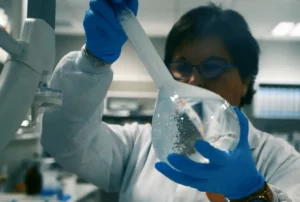
Implementing quality by design (QbD) in pharmaceutical development
The ICH Q8 pharmaceutical development guideline explicitly acknowledges that development programs vary in their level of rigor. Appendix 1 contrasts a minimal, empirical approach (fixed operating conditions, one-variable-at-a-time experimentation, reactive lifecycle management) with the enhanced quality-by-design pharmaceutical development approach, in which systematic multivariate experimentation and process understanding replace end-product testing as the primary quality assurance mechanism. For complex drug modalities, a minimal approach simply cannot generate the process understanding that regulators expect: when multiple variables interact to determine product quality, only systematic experimentation can reliably identify and control what matters.
QbD implementation in the pharmaceutical industry also shapes how process validation activities in pharma are structured. When the design space is established through systematic experimentation, process performance qualification and continued process verification are built on a pre-existing scientific foundation, rather than being the first attempt to understand the process. This reduces the risk of late-stage failures and supports more predictable regulatory interactions.
Analytical strategies supporting ICH Q8: from method development to control strategy
The scientific rigor demanded by the ICH Q8 guideline on pharmaceutical development depends entirely on the quality of the analytical methods that generate product and process knowledge. Analytical method development for pharma activities in a QbD-aligned program must be phase-appropriate, capable of detecting and quantifying all relevant CQAs, and designed with sufficient sensitivity to support risk assessment conclusions.

Several analytical activities are particularly critical:
- Early impurity profiling and forced degradation studies, which identify degradation pathways and inform stability-indicating method requirements before IND submission.
- Multivariate characterization of the design space, using techniques such as UHPLC-MS/MS, multi-attribute methods (MAM), and high-resolution mass spectrometry to map the relationship between process parameters and product quality attributes.
- Fit-for-purpose method qualification, calibrated to the development stage and the intended use of the data, whether for internal decision-making, toxicology batch release, or regulatory submission.
- Control strategy for pharmaceutical development integration, where analytical data from across the development program collectively justify specifications, in-process controls, and release testing approaches in the CTD submission.
Method development and validation activities should be aligned with the broader ICH framework: ICH Q2 defines the validation requirements for analytical procedures submitted in regulatory dossiers, while the more recent ICH Q14 extends QbD principles specifically to analytical procedure development, reinforcing the same science- and risk-based philosophy that underpins ICH Q8 pharmaceutical development.
In CMC pharmaceutical development, all of these analytical activities are integrated throughout, generating the data that justifies the design space, supports the control strategy, and provides the scientific rationale for specification setting.
At AMSbiopharma, we support ICH Q8 pharmaceutical development implementation across all CMC stages, from early CQA identification and impurity profiling through design space characterization and stability method development, using advanced platforms including UHPLC-MS/MS and multi-attribute methods.
Contact us to discuss how we can strengthen the scientific and regulatory foundation of your program.
References
European Medicines Agency. ICH Q8 (R2) Pharmaceutical development – Scientific guideline [Internet]. Amsterdam: EMA; 2009 [cited 2026 May 7]. Available from: https://www.ema.europa.eu/en/ich-q8-r2-pharmaceutical-development-scientific-guideline
