

Every biopharmaceutical produced in a living cell system carries an unavoidable burden: the proteins expressed by the host cell itself. These process-related impurities in biologics are present from the earliest stages of fermentation and must be systematically characterized, monitored, and removed before a product can be considered safe for human administration. Managing host cell proteins in biologics development is one of the most analytically demanding and regulatorily consequential challenges in biopharmaceutical manufacturing. The methods chosen to detect and control HCPs shape the entire downstream strategy, influence regulatory submissions, and ultimately determine what reaches the patient.
What are host cell proteins, and why they are a critical quality attribute in biologics
Host cell proteins (HCP) are endogenous proteins expressed by the production cell line (most commonly Chinese hamster ovary (CHO) cells) that co-exist with the recombinant therapeutic protein throughout fermentation and are released into the culture medium through normal cellular secretion or cell lysis as viability declines toward the end of a production run. HCP impurities can number in the thousands of distinct species, spanning a wide dynamic range of abundance relative to the drug product.
The relevance of HCP as a critical quality attribute stems from two distinct risk categories. First, specific HCPs have direct effects on product quality: proteolytic enzymes can cleave the therapeutic protein over its shelf life, lipases can destabilize lipid-based formulations, and abundant hitchhiker proteins may co-purify with the drug through affinity-based steps by associating tightly with the antibody itself. Second, host cell protein immunogenicity represents a patient safety concern residual HCPs that reach the final product can trigger immune responses, potentially generating anti-drug antibodies or eliciting adverse clinical effects, particularly in patients receiving repeated dosing.
Because the HCP profile of a bioprocess is not predictable from first principles and is sensitive to cell line, media composition, culture duration, scale, and process changes, monitoring must begin at harvest and continue through every downstream step. This is why HCP monitoring in biopharmaceutical manufacturing is classified as a critical quality attribute in regulatory guidance and not merely a characterization exercise.
HCP detection methods: when ELISA falls short, and LC-MS/MS takes over
The host cell protein ELISA remains valuable for routine process monitoring, but its limitations are structural. Because detection depends on polyclonal antibody recognition, the host cell protein assay captures only HCPs that elicit an immunogenic response during antibody generation. Low-molecular-weight proteins and weakly immunogenic species may escape measurement entirely, and ELISA provides no information about the identity or individual abundance of specific HCP species.
This is where liquid chromatography-tandem mass spectrometry (LC-MS/MS) HCP detection provides orthogonal value. The HCP ELISA vs LC-MS/MS comparison is not a question of which method is superior, but of how they complement each other:
- ELISA provides rapid, high-sensitivity total HCP monitoring for routine release decisions.
- LC-MS/MS provides molecular-level identity and relative abundance of each detected species.
- LC-MS/MS identifies HCPs that ELISA misses, including weakly immunogenic and low-molecular-weight species.
- ELISA–MS coverage analysis, combining immunocapture with mass spectrometric readout, allows direct evaluation of how many HCPs in a process sample are actually detected by a given ELISA antibody, generating data expressible as individual named protein coverage percentages.
For programs where specific HCP species pose stability or safety risks, biopharmaceutical impurities mass spectrometry is the only analytical approach capable of generating the evidence needed to act on them.
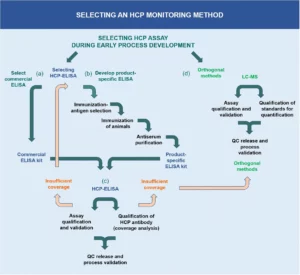
Figure 1. Selecting an HCP monitoring method. Source: Pilely K, Johansen MR, Lund RR, Kofoed T, Jørgensen TK, Skriver L, Mørtz E. Monitoring process-related impurities in biologics-host cell protein analysis. Anal Bioanal Chem. 2022 Jan;414(2):747-758.
HCP clearance strategies across downstream bioprocessing steps
HCP removal in biologic purification occurs progressively across multiple unit operations, and LC-MS/MS data are uniquely suited to informing this process. By generating identity and quantification data at each purification step, it is possible to track individual HCPs through the manufacturing train, identify which steps provide the greatest clearance for each species, and prioritize process modifications based on the identity of persistent impurities rather than on total ELISA values alone.
Downstream processing HCP removal strategies are guided by the physicochemical properties (molecular weight, isoelectric point, hydrophobicity, and product association) of the specific HCPs that survive early purification. Data-driven optimization using LC-MS/MS-derived HCP profiles can inform targeted adjustments:
- Ion exchange chromatography, pH, and ionic strength conditions can be tuned to exploit charge differences between persistent HCPs and the drug product, an adjustment only possible when the specific species are identified, and the isoelectric point data is provided.
- Size exclusion steps can be adjusted based on the molecular weight distribution of co-purifying species, using the protein-level identity and mass information.
- HCPs that associate tightly with the drug protein (so-called hitchhiker HCPs) are particularly difficult to remove. Identification of these species across purification stages is what enables the recognition of the problem and the redesign of the affected unit operations accordingly.
- In cases where specific HCPs are structurally similar to the drug protein and resist removal, LC-MS/MS-derived identity data can support the decision to implement gene knockout strategies in the host cell line.
The combination of ELISA for process consistency monitoring and LC-MS/MS for molecular-level HCP clearance in biologics assessment has been applied in regulatory license applications, providing the level of process understanding that modern regulatory frameworks require.

Regulatory expectations for HCP monitoring: FDA, EMA, and USP <1132>
FDA and EMA HCP regulatory oversight do not establish fixed numerical limits for residual HCPs in the final product. Instead, both agencies require manufacturers to demonstrate that HCP monitoring in biopharmaceutical manufacturing is supported by fit-for-purpose analytical methods, and that impurity levels are reduced as far as is consistent with product quality and patient safety. The risk associated with residual HCPs depends on the clinical context: dose, route of administration, patient population, and the identity and functional properties of the specific impurities present.

USP <1132> in host cell proteins (the United States Pharmacopeia chapter on residual HCP measurement in biopharmaceuticals) now explicitly recognizes LC-MS as complementary to ELISA for HCP characterization. HCP risk assessment in biologics under current expectations integrates persistence through purification, functional activity, patient exposure, and product association mechanisms, data that a combined ELISA and LC-MS/MS HCP detection strategy is specifically designed to generate.
At AMSbiopharma, we support host cell protein analysis across all stages of biopharmaceutical development, from early HCP profiling through purification process characterization and regulatory submission support, using advanced UHPLC-MS/MS platforms with DIA acquisition workflows.
Contact us to discuss how we can strengthen the analytical foundation of your HCP control strategy.
References
Pilely K, Johansen MR, Lund RR, Kofoed T, Jørgensen TK, Skriver L, Mørtz E. Monitoring process-related impurities in biologics-host cell protein analysis. Anal Bioanal Chem. 2022 Jan;414(2):747-758. doi: 10.1007/s00216-021-03648-2.
Seidel JD, Condina MR, Klingler-Hoffmann M, Young C, Donnellan L, Kyngdon C, Hoffmann P. Development of an Optimized LC-MS Workflow for Host Cell Protein Characterization to Support Upstream Process Development. J Proteome Res. 2025 Jan 3;24(1):234-243. doi: 10.1021/acs.jproteome.4c00637.
Tank P, D’Souza F, Kayalvizhi N, Rameshkumar N. Redefining biologics safety through advanced analytics: MS-based host cell protein profiling. Trends Biotechnol. 2026. doi: 10.1016/j.tibtech.2026.05.011.
United States Pharmacopeial Convention. <1132> Residual Host Cell Protein Measurement in Biopharmaceuticals. In: USP 39–NF 34. Rockville (MD): United States Pharmacopeial Convention; 2016. p. 1416-1436. Available from: https://ptacts.uspto.gov/ptacts/public-informations/petitions/1461631/download-documents?artifactId=m2zJVjTU7b9yFSarfJQR-91Z55uOO5kR3TKRDqo74EhBfuoR6gkiheU
