

Drug substance development sits at the foundation of every pharmaceutical program, yet it is often where the most consequential analytical and regulatory decisions are made with the least systematic rigor. The ICH Q11 development and manufacture of drug substances guideline, finalized in 2012, fills this critical gap in the ICH Q-series, focusing on process understanding, selection of starting materials, and building a control strategy capable of surviving regulatory scrutiny across the product lifecycle. ICH Q11 is therefore an essential reference for CMC drug substance development teams working across both chemical entities and biotechnological or biological drug substances.
From molecule to manufacturing: how ICH Q11 structures drug substance development
ICH Q11 guideline describes the approaches to developing and understanding the drug substance manufacturing process, and provides guidance on what information should be provided in Module 3 of the Common Technical Document (CTD), specifically sections 3.2.S.2.2 through 3.2.S.2.6. Specifically, its principles govern how sponsors establish the commercial manufacturing process, link process parameters and material attributes to drug substance Critical Quality Attributes (CQAs), develop a control strategy, and manage the manufacturing process across its lifecycle.
Like the ICH Q8 guideline for pharmaceutical development, ICH Q11 distinguishes between a traditional and an enhanced approach to process development that pharma teams encounter in practice:
- A traditional approach relies on set points and narrow operating ranges derived from batch history, with quality primarily assured through end-product testing.
- An enhanced approach applies risk management and systematic experimentation more extensively, using Design of Experiments (DoE), mechanistic models, and prior knowledge to map the relationships between process inputs and drug substance quality attributes, and to establish a design space where warranted.
The relationship between ICH Q11 and Q8 guidelines is one of complementarity rather than duplication. Q11 applies Q8’s Quality by Design (QbD) concepts specifically to the drug substance side of the CTD, which is governed by different regulatory sections and raises distinct analytical challenges around impurity formation, fate, and purge.

Rethinking API starting materials: regulatory expectations and scientific justification in ICH Q11
One of the most operationally significant (and frequently misapplied) aspects of ICH Q11 in drug substance development is the framework for selecting and justifying starting materials. The starting material definition by ICH Q11 establishes that it must be a substance of defined chemical properties and structure that is incorporated as a significant structural fragment into the active ingredient, but this criterion is frequently misinterpreted. It is not intended to dictate where in the synthesis the starting material sits. Rather, it distinguishes starting materials from reagents, catalysts, and solvents.
Selection requires considering all of the following principles together:
- Steps that impact the drug substance impurity profile should normally be included in the manufacturing process described in the CTD, where “impact” is defined by specific thresholds for non-mutagenic and mutagenic impurities drawn from the broader ICH framework.
- Enough of the manufacturing process must be described for regulatory authorities to understand how impurities are formed, how process changes could affect their formation and purge, and why the proposed control strategy is appropriate.
- Commercially available chemicals generally need not be justified against the Q11 general principles, while custom-synthesized chemicals require full justification.
Each starting material specification must include identity and purity controls with acceptance criteria for specified, unspecified, and total impurities, supported by validated analytical method development procedures for Active Pharmaceutical Ingredients (API), including UHPLC-MS/MS-based approaches sensitive enough to detect impurities at or below regulatory thresholds, particularly where mutagenic impurities are a concern.

Building process understanding: linking development data to robust control strategies
The ICH Q11 control strategy framework defines a control strategy as a planned set of controls derived from current product and process understanding that assures process performance and drug substance quality. What distinguishes an ICH Q11-aligned control strategy from a minimal approach is how it is derived, not from batch data alone, but from a systematic understanding of which material attributes and process parameters impact drug substance CQAs and why.
Under an enhanced approach, pharmaceutical manufacturing process development follows a structured sequence:
- Identifying sources of process variability through risk assessment.
- Designing studies, including multivariate DoE, mechanistic evaluations, and kinetic modeling.
- Establishing functional relationships between process inputs and quality outputs.
- Translating that understanding into defensible operating ranges or a design space.
For chemical entities, understanding how impurities form, evolve, and are removed (or persist) across multiple synthetic steps is central to ICH Q11 development and manufacture compliance. Whether an impurity introduced early will be adequately purged by downstream processing, or will carry through to the drug substance, cannot be assumed. It requires advanced analytical methods, such as UHPLC-MS/MS impurity profiling and orthogonal chromatographic techniques, capable of detecting and quantifying impurities at each relevant stage of the synthesis, not only at the point of final drug substance release.
Translating ICH Q11 into practice: analytical workflows and CMC decision-making
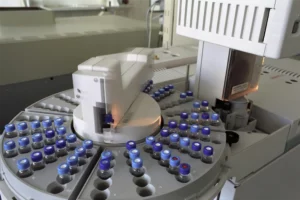
Translating ICH Q11 development and manufacture principles into CMC drug substance development practice requires analytical workflows that go well beyond release testing and cover each stage of the process:
- Early-stage impurity profiling, to identify actual and potential impurities generated across the synthesis, inform starting material justification, and prioritize which steps must be captured within the manufacturing process description. A task that demands orthogonal analytical platforms, from high-resolution mass spectrometry for unknown identification to ICP-MS for elemental impurities introduced by metal catalysts and reagents.
- Forced degradation and stability studies to characterize degradation pathways, establish stability-indicating method requirements, and support shelf-life specifications.
- Analytical method development and validation aligned with ICH Q2 and ICH Q14, progressing from fit-for-purpose qualification in early development to full validation as the program advances toward registration.
- Control strategy integration, where impurity profiling, elemental analysis, and stability data collectively justify specifications, in-process controls, and release testing approaches across the CTD sections governing drug substance quality.
API lifecycle management ICH expectations under Q11 Section 9 extend these responsibilities beyond approval. It states that any manufacturing change must be evaluated for its impact on drug substance quality, including whether existing analytical procedures retain the sensitivity to detect current and potential new impurities.
At AMSbiopharma, we support sponsors at every stage of the implementation of ICH Q11 principles during the drug substance development by combining advanced equipment, such as UHPLC-MS/MS platforms, with deep expertise in ICH Q-framework requirements for both chemical entities and complex biological modalities.
Contact us to discuss how we can strengthen the analytical foundation of your drug substance development program.
References
European Medicines Agency. ICH Q11 development and manufacture of drug substances (chemical entities and biotechnological/biological entities) – Scientific guideline [Internet]. Amsterdam: EMA; 2012 [cited 2026 May 8]. Available from: https://www.ema.europa.eu/en/ich-q11-development-manufacture-drug-substances-chemical-entities-biotechnological-biological-entities-scientific-guideline
European Medicines Agency. Questions and answers – ICH guideline Q11 on development and manufacture of drug substances (chemical entities and biotechnological/biological entities) [Internet]. Amsterdam: EMA; 2017 [cited 2026 May 8]. Available from: https://www.ema.europa.eu/en/documents/other/questions-and-answers-ich-guideline-q11-development-and-manufacture-drug-substances-chemical-entities-and-biotechnological-biological-entities_en.pdf
