Two formulations of the same active ingredient rarely behave identically in the body, and drug development depends on saying, with statistical confidence, when that difference is small enough to ignore. The bioequivalence study is the pharmacokinetic tool that makes this call, most often clearing the path for a generic sponsor to rely on the innovator’s safety and efficacy data instead of repeating a full clinical program.
What is bioequivalence and why does it matter for generic drug approval?
A generic must satisfy three linked concepts before it can reach the market:
- Pharmaceutical equivalence: identical active ingredient, strength, dosage form, and route of administration as the reference product
- Bioequivalence: absence of a significant difference in absorption rate and extent at the same molar dose
- Therapeutic equivalence: the result when a product is both pharmaceutically equivalent and bioequivalent, making it interchangeable with the reference
Together, these three concepts constitute the definition of bioequivalence that pharmacy teams rely on when comparing a generic to its reference product. Bioavailability (BA) and bioequivalence (BE) are related but not interchangeable terms. The difference is that BE compares two formulations against each other, not one product alone, which is precisely why generic drug bioequivalence substitutes a comparative pharmacokinetic study for repeating the innovator’s clinical trials.
When is a bioequivalence study required? Regulatory triggers and biowaivers
An Abbreviated New Drug Application (ANDA) must reference an approved Reference Listed Drug and submit in vivo evidence or qualify for a waiver. ANDA bioequivalence requirements sit in Product-Specific Guidance, which recommends the most sensitive approach per molecule. Several categories qualify for a biowaiver bioequivalence, an exemption from in vivo bioequivalence testing altogether:
- Parenteral, otic, and ophthalmic solutions qualitatively and quantitatively identical to the reference product
- Oral or topical solutions with no inactive ingredients affecting absorption
- Drugs already reviewed under the Drug Efficacy Study Implementation (DESI) program
- Products qualifying under the Biopharmaceutics Classification System (BCS) bioclassification system, historically limited to Class I and III but now extended by WHO to all four classes, with topical systems and oral films also considered
Most biowaiver categories also require showing a Q1/Q2 excipient match, meaning identical qualitative composition and quantitatively similar amounts, for any component likely to affect absorption.
Bioequivalence study design: crossover trials, fed/fasted conditions and statistical framework
The standard bioequivalence study design for oral products is a randomized, two-period, two-sequence, single-dose crossover, where each of at least 12 healthy subjects receives both formulations after a washout period. This BE study crossover design controls inter-subject variability by letting each participant serve as their own control; parallel designs suit drugs with very long half-lives, and replicate designs suit highly variable compounds.
Two arms are usually paired in a fed-fasted bioequivalence study, since absorption differs by state: fasting is the most sensitive way to detect formulation differences, while a fed arm, after a high-fat meal, confirms performance holds up with food. Pharmacokinetic endpoints bioequivalence is actually measured through an Area under the curve (AUC) and maximum concentration (Cmax) bioequivalence comparison between test and reference. The former captures total exposure, while the latter captures peak exposure. The 90% confidence interval bioequivalence criterion decides the outcome, requiring the test/reference ratio for Cmax and AUC to fall within 80.00–125.00%.
Getting this design right and sequencing the fasting and fed arms correctly determine whether the resulting data will hold up under regulatory review.
Bioanalytical methods for BE studies: LC-MS/MS, method validation and ICH M10 requirements
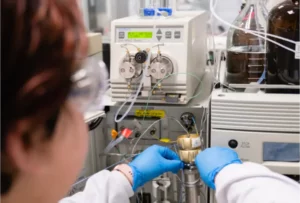
Every pharmacokinetic parameter behind a bioequivalence submission depends on a method sensitive enough to survive regulatory inspection. Liquid chromatography coupled with tandem mass spectrometry (LC-MS/MS) is now the default platform for quantifying plasma concentrations, and any method built on it must pass validation under the ICH M10 guideline, which merges what were previously separate US Food and Drug Administration (FDA) and European Medicines Agency (EMA) expectations into one framework:
- Selectivity and matrix effect testing across six plasma sources, with matrix effect held to ±15% accuracy/precision and selectivity checked against interference thresholds.
- A calibration curve across the quantification range, accuracy within ±15% (±20% at Lower Limit of Quantification).
- Stability testing across freeze-thaw, bench-top, and long-term storage.
- Incurred sample reanalysis, confirming real samples reproduce within range.
FDA and EMA bioequivalence guidelines: requirements, submission standards and global harmonization
FDA bioequivalence guidance documents, including ‘Bioequivalence Studies with Pharmacokinetic Endpoints’ and ‘Statistical Approaches to Establishing Bioequivalence’, define design expectations behind every ANDA submission. On the European side, the EMA bioequivalence guideline framework has moved toward the same endpoint: since January 2025, ICH M13A supersedes EMA’s own guideline for non-replicate crossover designs in immediate release (IR) solid oral forms, with M13B and M9 extending the same logic. Together, these ICH guidelines for bioequivalence studies give sponsors one package that satisfies both agencies. For complex generics, physiologically based pharmacokinetic modeling is gaining traction with both FDA and EMA as a complement to traditional bioequivalence studies.
Designing a compliant bioequivalence program, from crossover protocol through ICH M10-validated bioanalysis to the final report, demands analytical capacity most sponsors lack in-house. At AMSbiopharma, we support generic drug development with bioequivalence CRO services built around validated UPLC- and HPLC-MS/MS bioanalytical methods, ICH M10-aligned method validation, and regulatory-ready study reports for ANDA and EU submissions.

References
Dhake PR, Kumbhar ST, Gaikwad VL. Biowaiver based on biopharmaceutics classification system: Considerations and requirements. Pharm Sci Adv. 2023 Oct 17;2:100020. doi: 10.1016/j.pscia.2023.100020
European Medicines Agency. ICH M10 on bioanalytical method validation – scientific guideline [Internet]. Amsterdam: EMA; 2022 [cited 2026 Aug 11]. Available from: ema.europa.eu European Medicines Agency.
ICH guideline M13A on bioequivalence for immediate-release solid oral dosage forms – scientific guideline [Internet].
Amsterdam: EMA; 2024 [cited 2026 Aug 11]. Available from: https://www.ema.europa.eu/en/ich-guideline-m13a-bioequivalence-immediate-release-solid-oral-dosage-forms-scientific-guideline
Myung JH. Introduction of bioequivalence for generic drug products [Internet]. Silver Spring (MD): CDER, Office of Generic Drugs, U.S. FDA; 2022 [cited 2026 Aug 11]. Available from: fda.gov
