
Every small-molecule drug candidate must clear two analytical hurdles before it reaches a regulatory filing: confirmed chemical identity and a defined metabolic fate once dosed in a biological system. Both depend on mass spectrometry (MS) applications spanning structural confirmation, impurity control, and metabolism studies. Few single techniques cover so much of the drug development lifecycle, which is why mass spectrometry services sit at the center of most pharmaceutical analytical services portfolios.
What types of mass spectrometry services are used in small molecule drug analysis?
Pharmaceutical mass spectrometry for small molecules spans several complementary platforms, each suited to a different analyte class:
- Chromatography-coupled MS: LC-MS/MS couples liquid chromatography, most often in its high-performance (HPLC) or ultra-high-performance (UHPLC) forms, with tandem mass detection, and is the workhorse for drug purity analysis, impurity profiling, and quantitative bioanalysis. GC-MS, using gas-phase separation, remains the reference for volatile, thermally stable analytes such as residual solvents and genotoxic impurities.
- Tandem MS (MS/MS): fragments ions across successive stages to yield the structural detail that underpins metabolite and impurity characterization.
- ICP-MS: uses an inductively coupled plasma to ionize and atomize elements, covering elemental and trace-metal impurity limit testing that organic MS cannot resolve.
- High-resolution MS (HRMS): where identity must be established without reference standards, accurate-mass analyzers enable direct molecular formula assignment. These accurate-mass analyzers are often deployed in hybrid configurations that pair them with a quadrupole for precursor-ion selection, such as Q-TOF or Q-Orbitrap, and the analyzer chosen shapes the application.
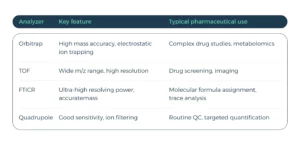
Table 1. Comparison of high-resolution mass spectrometry analyzer types used in pharmaceutical analysis
Beyond these core platforms, emerging approaches extend the analytical toolkit further. Native MS characterizes protein-drug binding in early discovery, ambient ionization enables rapid open-air screening with minimal sample preparation, and mass spectrometry imaging (MSI) maps how a parent drug and its metabolites distribute across tissue.
Structural elucidation and molecular characterization with high-resolution mass spectrometry
Structural elucidation in pharmaceutical work addresses two linked tasks: confirming that a synthesized compound matches its intended structure, and identifying any impurities, degradants, or unexpected species alongside it. High-resolution mass spectrometry for drug development relies on accurate mass measurement, often sub-5-ppm error, to assign molecular formulas with confidence, resolving elemental composition directly from exact mass without the additional measurements low-resolution systems require.
The molecular formula reveals which atoms are present, but not how they are connected. In practice, high-resolution instruments operate in tandem mode, combining accurate mass with fragmentation in a single workflow: tandem MS breaks a precursor ion into product ions that act as puzzle pieces for reconstructing the structure. Collision-induced dissociation (CID) is most common, while orthogonal methods such as ultraviolet photodissociation (UVPD) and electron-transfer dissociation (ETD) add complementary fragmentation.
Several capabilities extend this further:
- Intact mass analysis establishes the molecular weight of the intact compound as a first characterization step, before fragmentation.
- Ion mobility spectrometry (IMS) adds a shape-based separation dimension, distinguishing isomers that share identical fragmentation spectra.
- Quantitative mass spectrometry data are frequently paired with nuclear magnetic resonance (NMR), which contributes atom-connectivity information to resolve positional isomers.
Multiple orthogonal methods are necessary because vendor-supplied structures are not always correct. Small molecule characterization cannot rely on a single confirmatory run since a misassigned structure carried forward can invalidate downstream biology and regulatory data.
Drug metabolism studies and metabolite identification by mass spectrometry
Once a compound’s structure is confirmed, characterization shifts to its metabolic fate: how the molecule is biotransformed once it enters a biological system. Metabolite identification in drug metabolism studies has moved from early LC-MS to today’s HRMS-dominated methods, which combine Orbitrap or Q-TOF platforms with LC, and increasingly ion mobility, to find metabolites in complex matrices such as plasma or hepatocyte incubations. Most of this work starts in vitro, where liver microsome incubations with Phase I and Phase II cofactors reproduce real metabolic pathways.
Drug metabolite profiling has two goals. On the one hand, flagging metabolic soft spots early enough to guide the redesign of later analogs. On the other hand, characterizing any active, reactive, or toxic metabolite that carries safety implications. The two roles of tandem MS divide the work: targeted LC-MS/MS drug metabolism studies on triple-quadrupole instruments quantify known metabolites, while HRMS identifies unknown ones. Together with metabolic stability testing mass spectrometry analysis, they feed a chemistry program without waiting on a reference standard for every metabolite. Pinpointing the exact site of change of metabolism on the molecule is often the hardest step. Standard collision-induced dissociation (CID) frequently fails, especially for glucuronidation, where methods such as electron-activated dissociation (EAD) resolve the assignment.

Mass spectrometry applications across the drug development lifecycle
The role of mass spectrometry shifts as a compound moves from discovery to market, dominating early development but narrowing to a targeted role in routine quality control, where a single well-characterized method often suffices for a small-molecule drug. The mass spectrometry applications that matter most for small-molecule characterization fall into a few phases:
- Discovery and lead screening: MS-based metabolomics links genotype to phenotype through small-molecule biomarkers, while high-throughput methods such as acoustic ejection MS (AEMS) accelerate screening and early profiling of absorption, distribution, metabolism, and excretion (ADME).
- ADME and pharmacokinetic profiling: chromatography–MS tracks each ADME process with high sensitivity, while mass spectrometry imaging (MSI) resolves how a parent drug and its metabolites distribute across tissue, extending into toxicology, where that spatial data supports safety assessment.
- Clinical and quality control: LC-MS/MS is the established gold standard for therapeutic drug monitoring, delivering the specificity and multi-analyte quantification behind personalized dosing, and it anchors the release and stability testing behind regulatory submissions
Choosing an analytical CRO for MS services: capabilities, regulatory standards and workflows
Few sponsors can maintain in-house every platform a small-molecule program needs, alongside the method-development expertise each requires. An analytical CRO mass spectrometry partner fills that gap, matching methods to each stage of development and validating them to hold up under FDA and EMA review. Bringing structural analysis, metabolite identification, and impurity testing under one roof also removes the vendor handoffs that slow a program down.
At AMSbiopharma, our mass spectrometry drug characterization services support small-molecule structural analysis, metabolite identification, and drug substance testing, combining advanced UHPLC-MS/MS, GC-MS, HRMS, and ICP-MS with regulatory-aligned method development.

References
Baell JB, Pauli GF, Fillmore M, et al. Practical Recommendations for Small-Molecule Characterization in Preclinical Research. 2026 Jun 10. In: Markossian S, Grossman A, Baskir H, et al., editors. Assay Guidance Manual [Internet].
Bethesda (MD): Eli Lilly & Company and the National Center for Advancing Translational Sciences; 2004-. Available from: https://www.ncbi.nlm.nih.gov/books/NBK623671/
Deschamps E, Calabrese V, Schmitz I, Hubert-Roux M, Castagnos D, Afonso C. Advances in Ultra-High-Resolution Mass Spectrometry for Pharmaceutical Analysis. Molecules. 2023 Feb 22;28(5):2061. doi: 10.3390/molecules28052061
Khalikova M, Jireš J, Horáček O, Douša M, Kučera R, Nováková L. What is the role of current mass spectrometry in pharmaceutical analysis? Mass Spectrom Rev. 2024 May-Jun;43(3):560-609. doi: 10.1002/mas.21858
